✦ Origins and Historical Context ✦
The ballet's roots lie in poetry. In 1876 the Symbolist poet Stéphane Mallarmé published L'Après-midi d'un faune, a dreamy monologue in which a faun - the half-human, half-goat creature of ancient myth - wakes in the heat of a Sicilian afternoon and tries to recall an encounter with two nymphs. Did it really happen, or did he dream it? The poem never says, drifting instead between memory, desire and fantasy. Its first edition was illustrated by Édouard Manet.
The ballet was the first work choreographed by Vaslav Nijinsky, the Ballets Russes' brilliant young star. Sergei Diaghilev was eager to see his protégé create, and in early 1911 Nijinsky and his sister, Bronislava Nijinska, worked out the first ideas together in St. Petersburg and showed them to Diaghilev and Léon Bakst. Nijinsky found his inspiration in ancient Greek art - the flat, profiled figures of archaic vase painting and relief sculpture - and set out to make bodies on stage look like a frieze come to life.
The work proved astonishingly demanding to create. Nijinsky's unfamiliar movement language took around ninety rehearsals to master, an enormous number for a ballet lasting about twelve minutes. The time and attention lavished on the young choreographer deepened tensions with Michel Fokine, the company's chief choreographer, who left the Ballets Russes after the 1912 season.
♫ The Music ♫
Claude Debussy's Prélude à l'après-midi d'un faune was first performed in Paris on December 22, 1894, and was never intended for dance. Debussy described it as a very free illustration of Mallarmé's poem - not a retelling of its story but a succession of moods: languor, heat, half-remembered desire. Mallarmé himself was reportedly delighted by it.
The score opens with one of the most famous solos in all music: an unaccompanied flute winding slowly down and back up through a chromatic phrase, as if the Faun were idly playing his pipes in the afternoon sun. From there the music drifts and dissolves, with shimmering harps, muted horns and floating harmonies that seem to refuse to settle into any fixed key. Many musicians regard it as the starting point of modern music; the composer and conductor Pierre Boulez famously traced the awakening of modern music to this very flute solo.
Strikingly, Nijinsky did not try to follow the music's flowing phrases. His dancers move in sharp, deliberate, sculptural poses against Debussy's soft-edged sound - a deliberate tension between eye and ear that puzzled many early listeners, including, reportedly, Debussy himself.
📖 The Story 📖
The Faun at Rest
On a hillside in an imagined ancient Greece, a young Faun lies stretched out on a rocky mound in the drowsy heat of the afternoon. As the flute melody unfolds, he lazily plays his pipe and lifts bunches of grapes to his lips, savouring them with an animal's unhurried pleasure. He is alone, idle and entirely at home in the natural world.
The Nymphs Arrive
A group of nymphs enters, moving in profile across the narrow strip of the stage like figures painted around the side of a Greek vase. They have come to bathe in a nearby stream. Last to arrive is the Chief Nymph, who lets her veils fall one by one, and her companions gather around her.
The Faun notices them. Curious and aroused, he rises and climbs down from his mound. Seeing him, the nymphs take fright and scatter, carrying away the discarded veils - all except the Chief Nymph, who remains, uncertain whether to stay or flee.
The Encounter
The Faun and the Chief Nymph circle one another warily. In the ballet's only true jump, the Faun springs towards her; for a brief moment they come together, their arms linked, in a strange, tense duet of angular shapes and averted gazes. Then she slips free and runs away, leaving behind one of her scarves.
The Faun picks up the scarf and examines it with intense curiosity. The other nymphs return to taunt and challenge him, but he will not give it up, and they flee once more.
The Scarf
Alone again, the Faun carries the scarf back up to his rock as though it were a prize. He lays it down carefully, gazes at it, and slowly lowers himself onto it. As Debussy's music fades to silence, his body gives a final convulsive movement - a frank suggestion of sexual climax - and he lies still. The encounter he could not complete in reality has been fulfilled in fantasy, just as Mallarmé's Faun loses himself in dreams of what might have been.
⚡ The Scandal of 1912 ⚡
The ballet premiered at the Théâtre du Châtelet in Paris on May 29, 1912, conducted by Pierre Monteux. The audience reaction was split between applause and booing, and the ballet was immediately performed a second time. The following morning, Gaston Calmette, editor of the influential newspaper Le Figaro, set aside his own critic's favourable review and published a front-page editorial of his own, condemning the Faun's final gesture as indecent and the whole spectacle as deserving of the boos it had received.
Paris quickly took sides. The sculptor Auguste Rodin, the most famous artist in France, praised Nijinsky's performance in a newspaper article bearing his name, comparing the dancer's beauty to that of antique sculpture; the painter Odilon Redon also wrote in support. Calmette turned his fire on Rodin himself. Police are said to have attended the second performance to check for obscenity, and the Faun's final movement may have been toned down for a time - but the controversy only made the ballet more famous, and audiences flocked to see it.
🎨 A Revolutionary Choreography 🎨
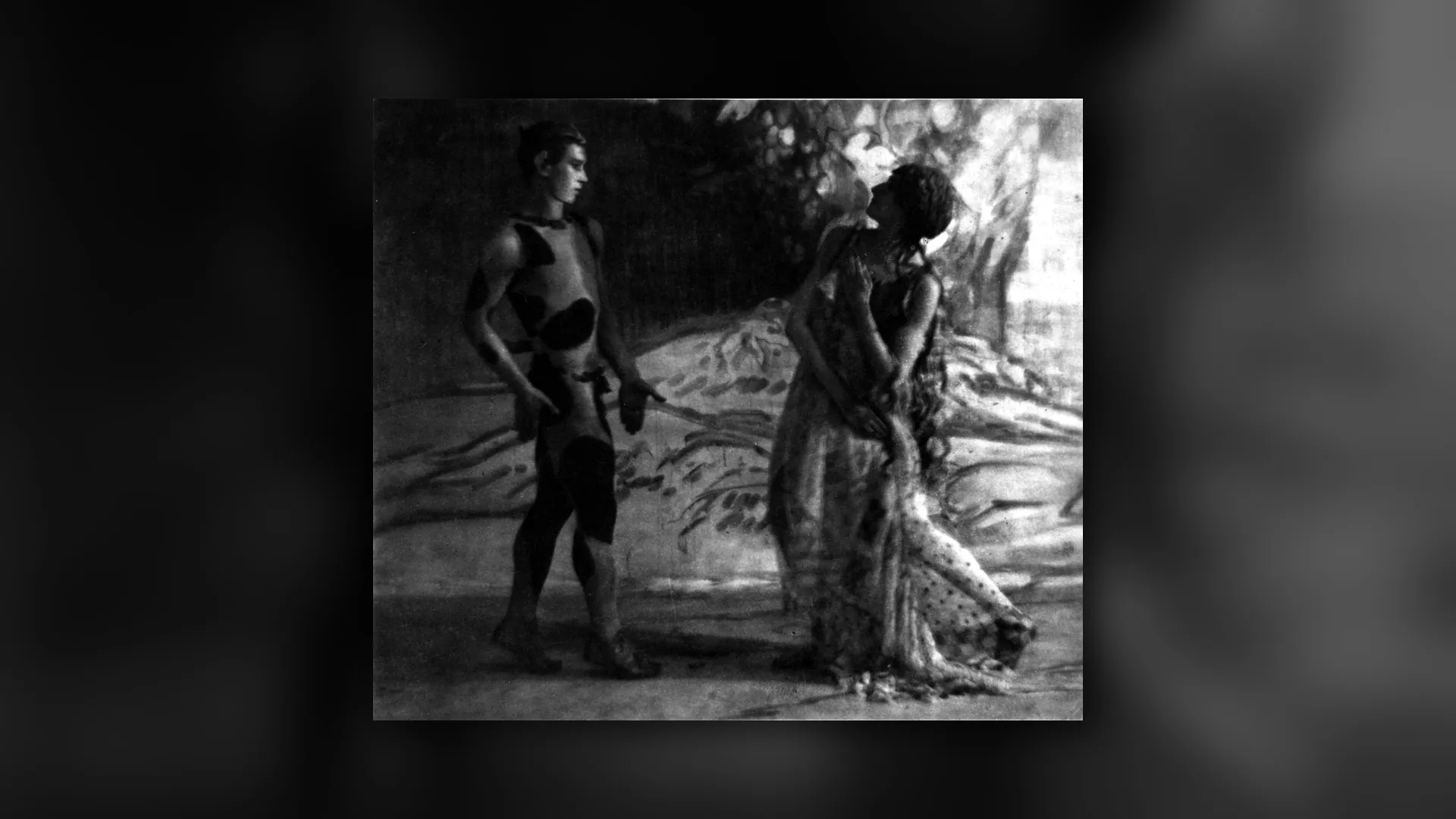
Classical ballet is built on turnout, vertical lift, and movement that travels freely in every direction. Nijinsky rejected almost all of it. His dancers keep their bodies turned towards the audience while their heads and feet face sideways in profile, hands held flat with angular, bent elbows. They walk with flexed feet and bent knees, stepping heel first along straight lines parallel to the footlights, rarely turning and almost never jumping. The stage itself was narrowed: Bakst's backcloth hung unusually far forward, so that the action unfolds in a shallow strip like a carved relief.
Bakst's designs completed the illusion of a living artwork. His softly painted backdrop of hazy greens, greys and browns evoked a sun-dappled landscape rather than depicting one precisely. Nijinsky's Faun wore a cream bodysuit painted with brown piebald patches, a short tail, a belt of vine leaves, and a close-fitting cap of golden hair with two small horns; even his ears were lengthened with wax to look more animal. The nymphs wore long, finely pleated white muslin tunics stencilled with blue or rust-red patterns, wigs of gold rope, and went barefoot.
The baron Adolf de Meyer photographed the production in 1912, and his soft-focus images - later published as an album in 1914 - are among the most beautiful dance photographs ever made. Along with Nijinsky's own notes, they would prove invaluable to later efforts to bring the original choreography back to life.
👑 Character Development 👑
The Faun
Half-human and half-animal, the Faun is a creature of instinct, appetite and curiosity, untouched by social rules. Nijinsky played him as something genuinely other - watchful, sensual and strangely innocent - and the role is defined less by virtuosity than by stillness, focus and the weight of every small gesture.
The Chief Nymph
More self-possessed than her companions, she is the only nymph who lingers when the Faun approaches. Torn between fascination and fear, she allows a brief moment of contact before escaping, leaving behind the scarf that becomes the Faun's consolation. The role was created by Lydia Nelidova.
The Nymphs
Moving in profile like figures on a Greek vase, the nymphs act almost as a chorus. Their flight, return and taunting of the Faun frame the central encounter, and their stylised unison movement creates the ballet's distinctive frieze-like patterns. Bronislava Nijinska danced among them at the premiere.
🔮 Themes and Symbolism 🔮
At its heart, L'Après-midi d'un faune is about desire and the imagination. The Faun's encounter with the nymphs is fleeting and incomplete; it is the scarf - a substitute, a souvenir - that allows him to turn a frustrated experience into private fantasy. Like Mallarmé's poem, the ballet leaves the boundary between what happened and what was dreamed deliberately blurred.
The work is also about the body as a form of expression. Where Romantic and Classical ballet idealised the body as weightless and graceful, Nijinsky made it earthbound, angular and frankly physical, communicating feeling through restriction rather than flow. By looking back to the art of ancient Greece he created something radically modern - using an archaic visual language to challenge the conventions of his own day.
Finally, the ballet refuses to moralise. The Faun can be read as playful, innocent, disturbing or lonely depending on the performance, and the absence of a tidy resolution leaves audiences to decide for themselves what they have witnessed.
⭐ Impact and Legacy ⭐
L'Après-midi d'un faune premiered on May 29, 1912 at the Théâtre du Châtelet in Paris, conducted by Pierre Monteux, with Nijinsky as the Faun, Lydia Nelidova as the Chief Nymph and Bronislava Nijinska among the nymphs. After the Paris scandal the Ballets Russes took it on tour; in Berlin in December 1912 it was danced before Kaiser Wilhelm II, and when it reached London in 1913 The Times called Nijinsky's performance "extraordinarily expressive." Rodin, meanwhile, invited the dancer to pose for him, though the sittings were cut short.
Unusually for a ballet of its era, Nijinsky's choreography was written down by its creator. In 1915 he recorded the whole work in a dance notation system of his own invention; the manuscript is now held by the British Library. For decades no one could read it, until the notation scholars Ann Hutchinson Guest and Claudia Jeschke cracked the code in the 1980s. Their reconstruction was staged at the Juilliard School in New York in 1989 and published in 1991 as Nijinsky's Faune Restored, allowing audiences to see the steps exactly as Nijinsky set them down.
The ballet had already been kept alive by dancers who learned it in Diaghilev's company. On April 20, 1931, Marie Rambert's company presented it in London, staged by Leon Woizikovsky and Lydia Sokolova, both of whom had danced in it for Diaghilev, and Rambert revived it again in 2012. Rudolf Nureyev danced the Faun at his London Coliseum season in 1983, The Royal Ballet staged it in 2000, and the Paris Opéra Ballet has also performed it.
The title has inspired new works too. Jerome Robbins' Afternoon of a Faun, created for New York City Ballet in 1953 with Francisco Moncion and Tanaquil Le Clercq, transposes the same Debussy score to a modern ballet studio, where two young dancers meet and watch themselves in an imaginary mirror - the audience. Through both Nijinsky's original and the works it inspired, this twelve-minute ballet remains one of the founding documents of modern dance.