✦ Origins and Historical Context ✦
When Sergei Diaghilev's Ballets Russes made its Paris debut in 1909, audiences were overwhelmed by the energy of its Russian dancers. For the 1910 season Diaghilev wanted something more: new works conceived from the start as total theatre, in which dance, music and painting carried equal weight. Scheherazade, which premiered at the Paris Opéra on June 4, 1910 - three weeks before The Firebird - was the spectacular result, and it became one of the defining successes of the company's early years.
Despite its title, the storyteller Scheherazade never appears. Instead, the ballet stages the episode from the frame story of One Thousand and One Nights that sets the whole collection in motion: King Shahriar, encouraged by his brother Shah Zeman, pretends to leave on a hunting trip and returns to find his wives betraying him with their slaves. In the Nights, this betrayal is what turns Shahriar into a tyrant who marries and executes a new bride each day - until Scheherazade stops him with her endless tales. The ballet, in other words, shows the crime that makes her stories necessary. The name of its heroine, Zobeide, was borrowed from other tales in the collection.
Credit for the scenario became a source of bitter dispute. The painter Alexandre Benois maintained that he had devised much of the story, but the printed programme credited Léon Bakst, the production's designer. Benois was deeply wounded and briefly fell out with Diaghilev. Today the libretto is usually attributed to Bakst and the choreographer Michel Fokine, with Benois' contribution acknowledged.
♫ The Music ♫
The score is Nikolai Rimsky-Korsakov's Scheherazade, Op. 35, a symphonic suite in four movements composed in 1888 and first performed in St. Petersburg under the composer's own baton. It is one of the most brilliantly coloured orchestral works of the 19th century, built around two great themes: a stern, heavy unison in the brass and strings representing the Sultan, and a sinuous, rhapsodic solo violin that represents Scheherazade herself, weaving her stories night after night.
Rimsky-Korsakov had deliberately removed the descriptive titles from his four movements so that listeners would not tie the music too closely to any one tale. Diaghilev's team did exactly the opposite, rearranging the suite to accompany a single continuous drama of its own invention. The composer had died in 1908, and his widow, Nadezhda Rimskaya-Korsakova, protested publicly against what she called the disarrangement of her husband's music. Audiences, however, were thrilled: the surging orchestration seemed to fuse perfectly with the colour of Bakst's designs, and the score's climaxes gave the drama a sense of mounting, inevitable catastrophe.
📖 The Story 📖
The Shah's Suspicion
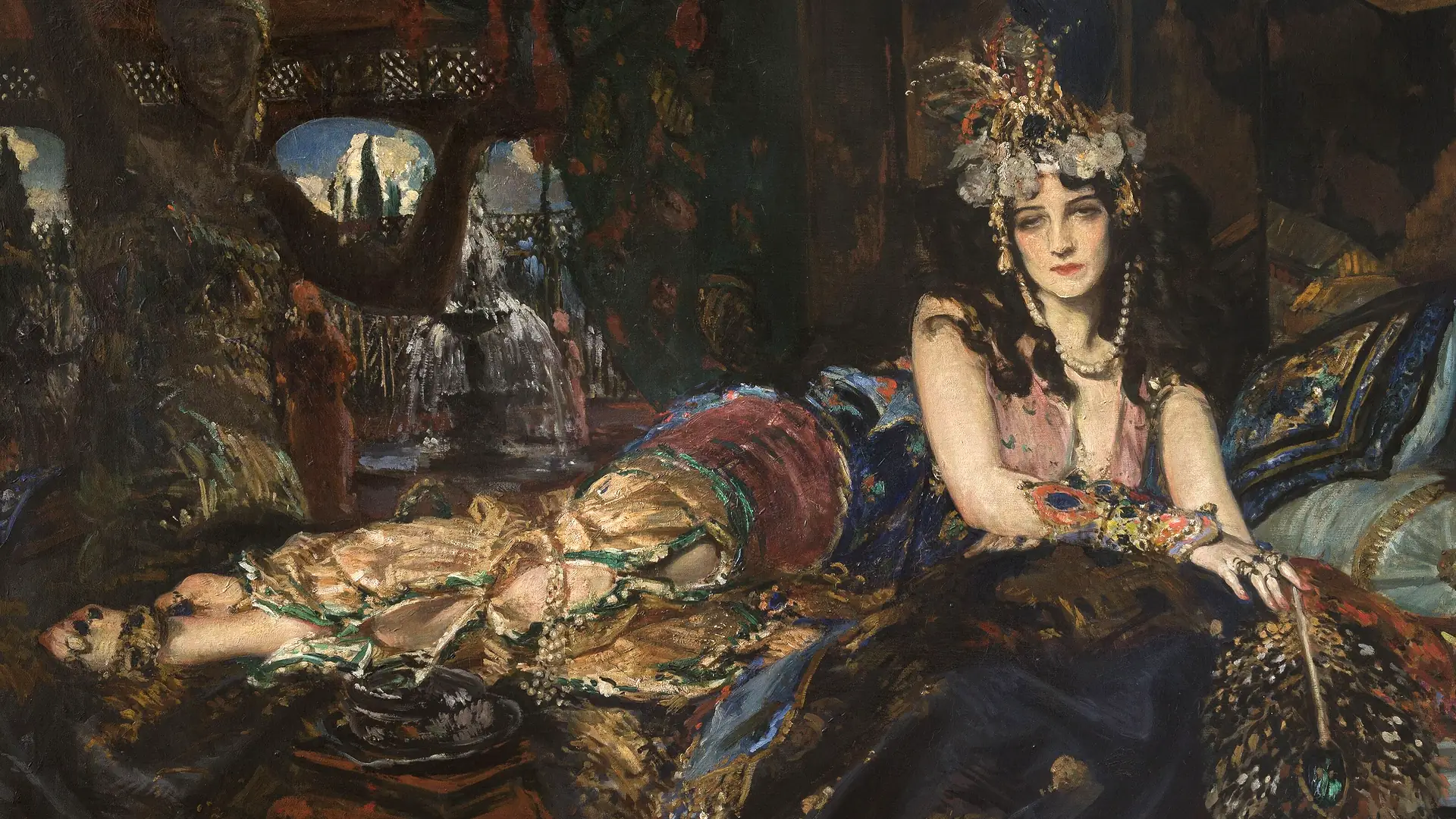
In the opulent harem of his palace, Shah Shahriar reclines among his wives and attendants, with his favourite, Zobeide, at his side. Beneath the luxury lies unease. His brother, Shah Zeman, is convinced that the women are unfaithful, and he urges Shahriar to put them to the test.
The two kings announce that they are leaving for a hunting expedition, and Shahriar departs with his brother and their retinue - intending to return long before anyone expects him.
The Golden Slave
No sooner have the kings gone than the wives surround the Chief Eunuch, coaxing and bribing him with jewels until he unlocks the doors to the slaves' quarters. Out pour the male slaves, who rush to join the women in delighted reunion.
Zobeide waits for one man alone. At her insistence the Eunuch opens one final door, and the Golden Slave springs out - gleaming, feline and full of barely contained energy. He goes straight to Zobeide, and the two become the centre of the drama, their duet charged with passion and with the danger of discovery.
The Orgy
Musicians strike up, servants bring fruit and wine, and the harem gives itself over to a wild celebration. Odalisques, slaves and almées dance in ever more abandoned groups as the music builds to a frenzy. At the heart of it all, Zobeide and the Golden Slave lose themselves in one another, the Slave leaping and whirling around her as the whole room seems to sway with desire.
The Shah's Revenge
At the height of the revel, Shahriar and Shah Zeman burst back into the harem with their soldiers. The music shatters; the dancing turns to panic. On the Shah's command the guards draw their scimitars and cut down the slaves and the faithless wives as they scatter in terror. The Golden Slave is slain in a last, spectacular death throe.
Only Zobeide is left. She throws herself at Shahriar's feet and begs for mercy, and for a moment the Shah, who still loves her, seems ready to relent. But Shah Zeman reminds him of her betrayal. Seeing that there is no hope, Zobeide seizes a dagger from one of the guards and stabs herself, dying at her master's feet. Amid the bodies in his ruined paradise, Shahriar is left alone with his grief.
🎨 Bakst and the Visual Spectacle 🎨
For many in the first audiences, the true star of Scheherazade was Léon Bakst. His set turned the stage of the Paris Opéra into a vast, enclosed tent of colour: towering swags of green and gold drapery, deep blues, reds and oranges, carpets, cushions and hanging lamps, all glowing in clashing jewel tones that no one had dared put on stage before. Bakst made no attempt at a historically accurate Persian court; instead he created a fantasy of colour designed to overwhelm the senses.
His costumes were equally daring - loose harem trousers, bare midriffs, ropes of pearls, plumed turbans and shimmering gold-and-silver fabrics - designed not just as decoration but to reveal and enhance the movement of the body. The Metropolitan Museum of Art describes the production as a major international triumph for Bakst, establishing the bold colour and sensual style that became the visual signature of the Ballets Russes.
The influence spilled out of the theatre almost immediately. Parisian fashion, interior decoration and jewellery all embraced the new taste for rich, saturated colour and orientalist motifs. The couturier Paul Poiret's turbans and harem trousers of the following years are often linked to Bakst's designs, though Poiret himself insisted he had arrived at his style independently.
✦ Fokine's Choreography and the Original Stars ✦
Michel Fokine conceived Scheherazade as a "choreographic drama," a single unbroken story rather than a string of dances. He was so determined to preserve its flow that he forbade the dancers to stop and acknowledge applause during the action. Some of the dancers performed barefoot, and Fokine replaced the turned-out positions of classical ballet with sinuous, serpentine arms, swaying torsos and expressive gestures. He was frank that he was not reproducing authentic Eastern dance: his inspiration came from books and paintings, filtered through his own imagination.
The role of Zobeide was created by Ida Rubinstein, a wealthy, strikingly tall and slender performer who was not a classically trained ballerina. Her Zobeide was conveyed almost entirely through stillness, pose and mime, yet her imperious presence made her one of the sensations of Paris. Rubinstein went on to found her own company and to commission major works, including Ravel's Boléro in 1928.
Vaslav Nijinsky danced the Golden Slave in a costume of gold. Alexandre Benois famously likened him to something between a cat and a snake - rippling, sensual and dangerous, with a quality of movement utterly unlike the courtly princes of 19th-century ballet. Legend has it that in the death scene he spun on his head before collapsing, though the story may owe more to the awe he inspired than to fact. The great teacher Enrico Cecchetti played the Chief Eunuch, and Alexis Bulgakov the Shah.
👑 Character Development 👑
Zobeide
The Shah's favourite wife is proud, passionate and fearless in pursuit of her own desire. Within the harem she seems all-powerful, commanding even the Chief Eunuch, but her freedom is an illusion. Her final choice to die by her own hand rather than at the Shah's order is her last act of defiance.
The Golden Slave
Zobeide's secret lover is pure physical energy - feline, exultant and reckless. He represents everything the rigid order of the palace forbids, and his brief hour of freedom ends in one of ballet's most dramatic death scenes.
Shah Shahriar
The ruler of the palace, powerful but tormented by suspicion. His love for Zobeide is real, and his moment of hesitation at the end reveals a man torn between tenderness and the pride of absolute authority - a pride that leaves him alone among the dead.
Shah Zeman
Shahriar's brother is the ballet's cold instigator. It is he who plants the seed of suspicion, proposes the false hunting trip, and - at the decisive moment - hardens his brother's heart against mercy.
🔮 Themes and Cultural Context 🔮
Scheherazade is driven by a few powerful contrasts: desire against authority, freedom against confinement, and beauty against violence. The harem looks like a paradise of colour, music and pleasure, but it is also a gilded prison, and the lovers' escape from its rules lasts only as long as the Shah's absence. The same jewel-bright room that hosts the revel becomes the scene of a massacre - and the ballet's splendour makes its brutal ending all the more shocking.
Any modern appreciation of the ballet also has to recognise its Orientalism: the European artistic tradition of imagining the Middle East and Asia as worlds of luxury, sensuality, despotism and danger. Scheherazade's palace is a theatrical fantasy rather than a portrait of any real culture, assembled from European imaginings of the Arabian Nights, and its depiction of the harem draws on stereotypes that shaped how Western audiences saw the East. Scholars have also noted how many in the original audience conflated Zobeide with the famous storyteller of the title.
Recognising this does not diminish the ballet's historical importance. Instead, it allows Scheherazade to be understood more fully - as a dazzling theatrical achievement and as a revealing product of its time.
⭐ Impact and Legacy ⭐
Scheherazade premiered on June 4, 1910 at the Paris Opéra, with choreography by Michel Fokine, designs by Léon Bakst, Ida Rubinstein as Zobeide and Vaslav Nijinsky as the Golden Slave. It became one of the most popular works the Ballets Russes ever presented: according to the Library of Congress, the company performed it more than five hundred times between 1910 and 1929. Diaghilev's company brought it to the Royal Opera House, Covent Garden, in 1912.
The ballet remained a staple of the Russian ballet companies that toured the world after Diaghilev's death, and in 1994 Andris Liepa staged a reconstruction at the Mariinsky Theatre in St. Petersburg, using designs based on Bakst's original sketches. That production has allowed modern audiences to experience the ballet much as Paris first saw it.
Choreographers have also returned to the story with fresh eyes. In 2009, for the centenary of the Ballets Russes, Alonzo King created a new Scheherazade for his LINES Ballet with a score by Zakir Hussain blending Eastern instruments with Rimsky-Korsakov's melodies, and Jean-Christophe Maillot made his own version for Les Ballets de Monte-Carlo. Perhaps the ballet's deepest legacy, though, is the idea it proved so vividly in 1910: that design, music and choreography could be equal partners in a single theatrical vision.