✦ Origins and Historical Context ✦
Le Spectre de la Rose began as a single line of French Romantic poetry. In 1838 Théophile Gautier published "Le Spectre de la rose" in his collection La Comédie de la Mort, a poem spoken by a rose that a young woman wore to a ball the night before: "Je suis le spectre d'une rose / Que tu portais hier au bal" - "I am the ghost of a rose that you wore yesterday at the ball." Cut from its stem and crushed against her heart, the flower has died, but it returns each night to haunt her dreams.
In 1910 the French writer and critic Jean-Louis Vaudoyer sent the designer Léon Bakst an idea for a ballet that would join Gautier's poem to Carl Maria von Weber's piano piece Invitation to the Dance. The timing was perfect. 1911 marked the centenary of Gautier's birth, and Sergei Diaghilev needed a new work for the Ballets Russes because Nijinsky's first ballet, L'Après-midi d'un faune, was not yet ready. Diaghilev reportedly regarded the piece as a pleasant trifle - yet it became one of the most loved works his company ever performed.
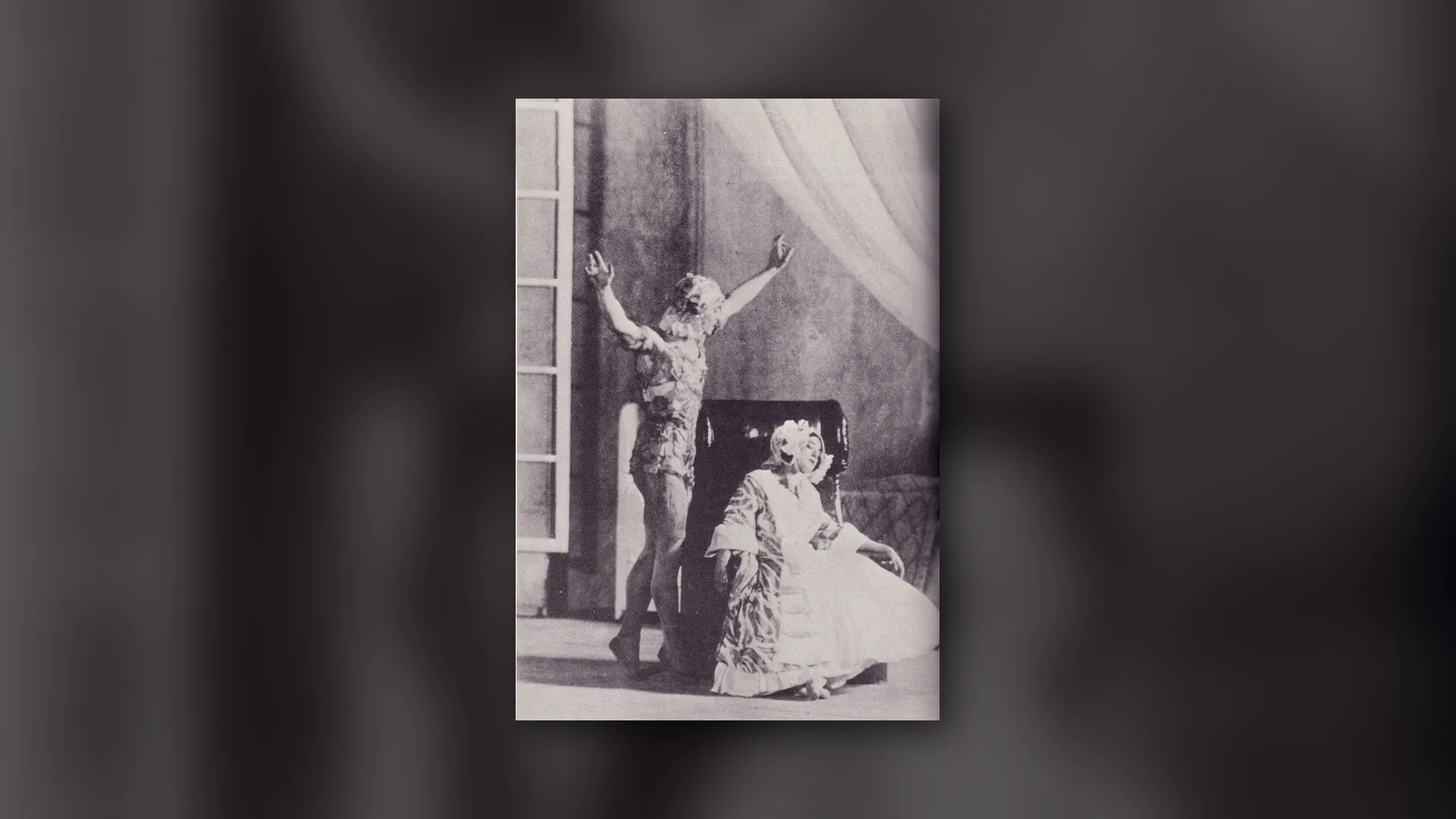
The ballet received its world premiere on April 19, 1911, at the Théâtre de Monte-Carlo in Monaco, with choreography by Michel Fokine, designs by Bakst, Tamara Karsavina as the Young Girl and Vaslav Nijinsky as the Spirit of the Rose. Lasting barely ten minutes and requiring only two dancers, it proved that a short, perfectly judged ballet could leave as deep an impression as a full evening of spectacle.
♫ The Music ♫
The score is Carl Maria von Weber's Aufforderung zum Tanz (Invitation to the Dance), Op. 65, written for solo piano in 1819. Weber attached a little story to the piece: a gentleman approaches a lady at a ball and asks her to dance; after some hesitation she accepts, they talk, they whirl through a waltz together, and at the end he thanks her and they part. It is often described as one of the first concert waltzes - a waltz meant to be listened to as much as danced to.
The ballet uses the orchestration made by Hector Berlioz in 1841, when the Paris Opéra staged Weber's opera Der Freischütz and, by house custom, required a ballet to be inserted into it. Berlioz gave the piano piece a glowing orchestral colour, opening with a warm solo cello. The quiet introduction and its gentle echo at the close frame the brilliant waltz at the centre - a structure that maps almost perfectly onto the ballet's own shape, from waking reverie, into the dream, and back to stillness. Music that was never written for this story seems, in Fokine's hands, to have been composed for nothing else.
📖 The Story 📖
The Return from the Ball
The curtain rises on a young girl's bedroom in about 1830, its tall French windows open to the summer night. The Young Girl enters, still in her white ball gown and bonnet, home from her very first ball. In her hand she carries a rose - a keepsake of the evening, perhaps a gift from a partner she cannot stop thinking about.
Dreamy and tired, she presses the flower to her face, reliving the music and the dancing. She sinks into an armchair, and as her thoughts drift back to the ballroom her eyes close. The rose slips from her fingers and falls to the floor.
The Spirit Appears
As the waltz begins, a figure bounds in through the open window: the Spirit of the Rose, the living essence of the flower she has dropped. He is not a man but a perfume, a memory, a dream given form - clothed in petals, his arms curling like tendrils.
At first he dances alone around the sleeping girl, circling her chair in soaring, buoyant leaps, as though the whole room were filled with the scent of roses. Then he draws her gently to her feet.
The Dream Waltz
Still asleep, her eyes closed, the Young Girl dances with the Spirit. Their duet is the heart of the ballet - tender, weightless and continuous, flowing from one phrase to the next without the pauses and poses of a conventional pas de deux. She is a sleepwalker in her own dream, reliving the joy of the ball with a partner who exists only in her imagination.
As the waltz reaches its climax, the Spirit guides her back to her armchair and settles her there once more, bending over her in a last gesture of farewell.
The Leap and the Awakening
With the final bars of the waltz the Spirit runs towards the window and leaps through it into the night - vanishing in a single soaring arc. It is one of the most famous exits in the history of ballet.
The music subsides into its quiet closing phrase. The Young Girl stirs and wakes, alone. For a moment she searches for something she cannot name; then she sees the rose lying on the floor where it fell. She gathers it up and holds it close, the dream already fading, its memory lingering like the scent of the flower.
🎨 Choreography and Design 🎨
Fokine is said to have created the ballet in just a handful of rehearsals, and he later described it as almost an improvisation. True to his belief that movement should serve the subject of each ballet, he abandoned the formal port de bras of the classical school for the Spirit. Instead the arms curve, curl and unfold like the stems and tendrils of a climbing rose, while the hands and wrists ripple softly. The result was a role that combined explosive power in the legs with an almost feminine delicacy in the upper body - something quite new for a male dancer.
Léon Bakst set the action in a Biedermeier bedroom of around 1830, the age of Gautier's poem: a pale, airy room with billowing curtains, an armchair, and two tall windows opening onto the night. The Young Girl wears a simple white gown and bonnet. The Spirit's costume was the sensation: a close-fitting suit of silk jersey covered in silk rose petals in shades of pink and red, with a cap of petals for his head. Nijinsky had to be stitched into it before every performance, and after each show the wardrobe mistress refreshed the curling petals with a curling iron. Romola de Pulszky, who later became Nijinsky's wife, described his made-up face as resembling "a celestial insect."
The famous final leap was as much stagecraft as athleticism. Accounts describe Nijinsky taking a short run and springing through the window, with a low sill making the jump appear even higher than it was. Out of the audience's sight, several men waited behind the set to catch him, and the conductor is said to have sustained the penultimate chord to prolong the illusion that he was still flying.
👑 Character Development 👑
The Young Girl
On the threshold of adulthood, newly returned from her first ball, she is the human heart of the ballet. Everything we see is her dream, and her feelings - wonder, longing, delight - must be conveyed largely with her eyes closed, through posture, timing and the softness of her response. Created by Tamara Karsavina, the role has been called "the forgotten woman of ballet," yet without her the Spirit would be merely a display of leaps.
The Spirit of the Rose
Neither man nor flower, the Spirit is the memory of a perfect evening made visible - a creature of scent and air who exists only for the length of a waltz. Nijinsky's performance in the role, with its extraordinary elevation and sensuous, curling arms, helped create the modern image of the male dancer as an artist of poetry and mystery rather than simply a partner for the ballerina.
🔮 Themes and Symbolism 🔮
A rose is beautiful precisely because it fades, and the ballet is built around that fragility. Cut from its stem and carried home from the ball, the flower is already dying - yet in the girl's dream it lives again more vividly than ever. Le Spectre de la Rose is a meditation on how an experience can end and still survive in memory, returning in a new and heightened form when we sleep.
The open window is the ballet's most important symbol: a threshold between the enclosed, ordinary world of the bedroom and the boundless world of dreams. The Spirit enters through it and returns through it, and the leap that carries him away marks the exact moment the dream ends. The girl's first ball, too, suggests a moment of transition - the first taste of romance and of adult life, with all the excitement and uncertainty that brings.
Above all, the ballet shows how little is needed to create a complete theatrical world: a flower, a bedroom, a waltz and two dancers. Its meaning is never fixed, and audiences can enjoy it as pure romantic fantasy or as a quiet reflection on youth, desire and the passing of time.
⭐ Impact and Legacy ⭐
Le Spectre de la Rose was an immediate success after its premiere on April 19, 1911 at the Théâtre de Monte-Carlo, and it quickly became one of the Ballets Russes' most popular works. The role of the Spirit became inseparable from Nijinsky's legend: photographs of him in Bakst's petal costume preserved the image long after the dancer himself had left the stage. Petals that fell from the costume during performances were eagerly sought by admirers, and it was said that Nijinsky's manservant, Vasili, sold so many as souvenirs that he built a house with the profits, nicknamed "the château of the Spectre de la Rose."
Dancers from Diaghilev's company carried the ballet into the wider repertoire. Karsavina herself staged it for Marie Rambert's dancers in London in 1930, and it entered the repertory of the Vic-Wells Ballet - forerunner of The Royal Ballet - in 1932. Its very brevity became a risk: by the mid-20th century it was often treated as little more than a showcase for the final leap, and few Spirits were judged to have matched Nijinsky.
Rudolf Nureyev did much to restore its poetry. He first danced the Spirit in the West for German television in 1961, performed it with Margot Fonteyn for the last time together in June 1979, and danced it 24 times with the Joffrey Ballet in New York that same year. In 1985 the Paris Opéra Ballet presented a production recreating the original choreography, sets and costumes, with Manuel Legris as the Spirit and Claude de Vulpian as the Young Girl, and The Royal Ballet staged a new production in 2004.
The poetic premise has also inspired entirely new works. Angelin Preljocaj created his own Le Spectre de la Rose in 1993 for six dancers, Thierry Malandain made another version in 2001, and Marco Goecke produced a strikingly contemporary interpretation for Les Ballets de Monte-Carlo in 2009 - each a tribute to how much imaginative power Fokine packed into ten minutes of dance.